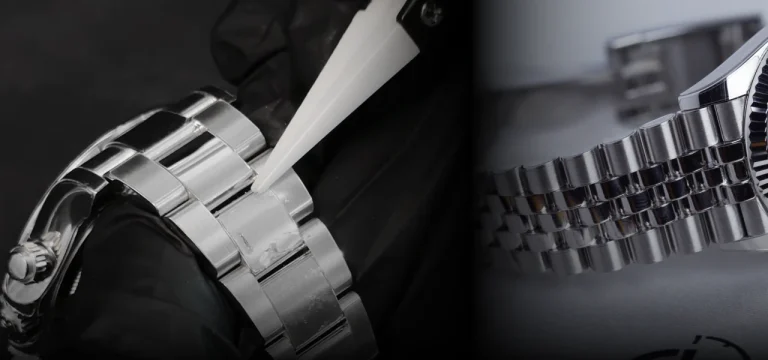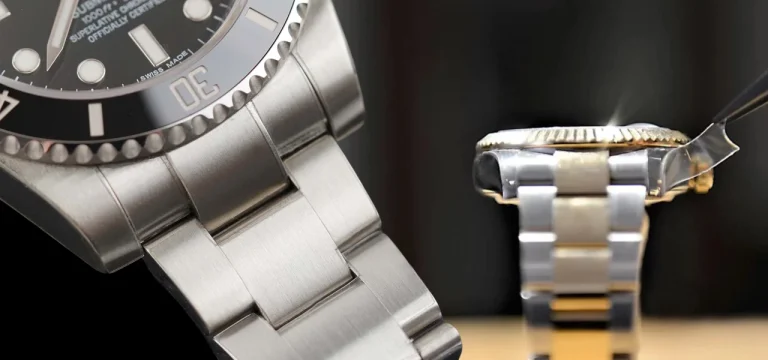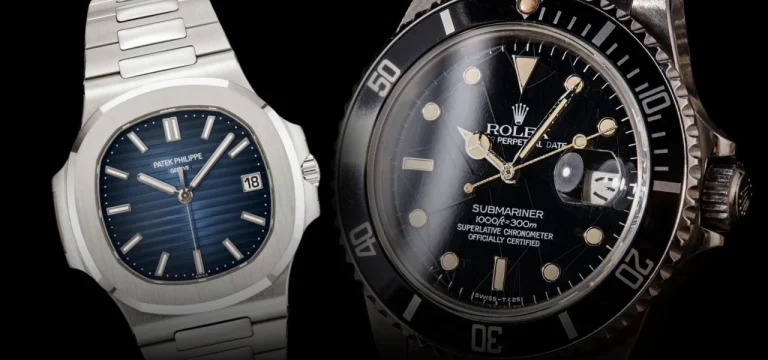


Drop your watch on a countertop, brush it against a doorframe, or catch it on a zipper, and Hesalite and sapphire crystals will tell two very different stories. One shows the mark almost instantly. The other barely notices.
Hesalite is the softer of the two, so it scratches more easily, but many light surface scuffs can be reduced with a suitable acrylic polish. Sapphire is far harder and resists scratches much better, staying clear for years, though a strong impact may cause it to chip or crack, requiring a full replacement.
No watch illustrates this trade-off better than the Omega Speedmaster Moonwatch, offered in nearly identical versions with either crystal. This guide breaks down how Hesalite and sapphire compare in scratch resistance, impact behavior, appearance, maintenance, cost, and everyday wearability.
Which Scratches Easier: Hesalite or Sapphire
Hesalite scratches more easily than sapphire. It’s a softer acrylic, while sapphire crystal rates around 9 on the Mohs hardness scale, just below diamond, and resists everyday scuffs far better.

The trade-off is that fine marks on Hesalite are generally easier and less expensive to address. Sapphire is more difficult to scratch, but true damage cannot usually be removed with the same simple polishing process.
Verdict: Sapphire wins for scratch resistance. Hesalite wins for easy, low-cost scratch removal.
What Is Hesalite Crystal
If you have spent time around vintage watches, you have probably encountered acrylic crystals under names such as Plexiglas, Perspex, or Hesalite. Hesalite is Omega’s name for this polymethyl methacrylate or PMMA-based material, which was widely used in watchmaking before sapphire became the modern standard.
Hesalite is incredibly lightweight and easy to shape, making it perfect for the beautifully domed crystals you see on vintage-inspired designs. It also has a certain warmth and softness to its appearance that sapphire just can’t quite replicate.
Its softer surface is more vulnerable to everyday marks, but its flexibility gives it different impact characteristics from sapphire. Rather than breaking into numerous sharp fragments, it is more likely to flex, crack, or deform under certain impacts. This behaviour helped make acrylic suitable for NASA-qualified Speedmasters.
Hesalite remains valued for its clarity, low weight, distinctive appearance, and historical connection to watches such as the Omega Speedmaster Moonwatch.
Why Hesalite Scratches More Easily
Because the Hesalite crystal has a softer surface, it can pick up marks from ordinary contact with desks, doorframes, zippers, bracelet hardware, and other hard objects. Even dust or debris trapped in a cleaning cloth may leave fine hairline scratches if the crystal is wiped without being rinsed first.
These marks often become more visible under direct light, especially on a highly domed crystal. Although light surface damage is often repairable, repeated polishing removes a small amount of acrylic each time and may gradually affect the crystal’s original profile or optical character.
What Is Sapphire Crystal
Sapphire watch crystal is not cut from a naturally mined blue gemstone. It is a colourless, lab-grown form of corundum made from aluminium oxide, with essentially the same crystalline structure and hardness as natural sapphire.
Manufacturers grow the material under controlled conditions before cutting it with diamond-coated tools and polishing it into shape. This demanding production process makes sapphire harder and more expensive to manufacture than acrylic.
At around 9 on the Mohs hardness scale, sapphire offers excellent transparency and strong resistance to everyday scratches. However, its hardness also makes it more brittle than Hesalite, particularly around the crystal edge.
Can Sapphire Still Scratch
Sapphire is highly scratch-resistant, but it is not scratch-proof. Diamond, silicon carbide, industrial abrasives, and materials with similar hardness can still leave visible marks.
Some apparent scratches may affect an external anti-reflective coating rather than the sapphire underneath. Sapphire may also chip along the edge or fracture after a concentrated impact, which usually requires professional inspection and, in serious cases, replacement.
Hesalite vs Sapphire: Key Differences
When choosing between Hesalite and sapphire crystals, it helps to understand how each material performs in everyday use. The table below highlights the key differences to help you decide which option best suits your needs.
| Feature | Hesalite | Sapphire |
| Material | Acrylic or PMMA | Synthetic aluminium oxide |
| Scratch resistance | Scratches relatively easily | Highly scratch-resistant |
| Scratch repair | Light marks can often be reduced by polishing | True scratches cannot usually be polished conventionally |
| Impact behaviour | More flexible and less likely to fragment sharply | Harder but more brittle |
| Appearance | Warm, domed, and vintage-inspired | Crisp, clear, and modern |
| Weight | Lighter | Slightly heavier |
| Cost | More affordable to replace | More expensive to manufacture and replace |
| Best for | Heritage-focused collectors | Frequent daily wearers |
Sapphire provides stronger everyday scratch resistance, while Hesalite offers easier cosmetic restoration when light surface marks appear.
Hardness vs Impact Resistance: Why Harder Isn’t Always Better
It sounds counterintuitive, but the scratch-resistant crystal isn’t automatically the tougher one. Hardness and toughness measure two different things: hardness is resistance to surface scratches, while toughness is resistance to cracking or shattering on impact. A material can rank high on one and low on the other, and that’s exactly what happens with these two crystals.
Hesalite is soft, but that softness comes with flex. Under a hard knock, it tends to scratch, dent, or crack rather than shatter into sharp pieces, so it degrades gracefully. Sapphire, on the other hand, is the opposite story: its hardness makes it rigid rather than flexible, so instead of absorbing an impact, it resists it right up until it doesn’t. A sharp knock against tile, concrete, or metal is more likely to chip the edge or fracture the crystal outright.
So neither material wins outright. Sapphire handles the slow grind of daily scuffs better than almost anything else on the market, but Hesalite can be the safer bet in a sudden, sharp impact, since it’s more likely to flex or crack than shatter.
Appearance and Dial Clarity
The choice of crystal influences more than just durability. It also affects how the dial looks, how light moves across it, and how the watch feels on the wrist.
Hesalite’s Vintage Appearance
Hesalite gives the dial a warmer, softer character. Its pronounced dome creates gentle distortion near the edge, especially when viewed from an angle. Many collectors value this effect because it closely resembles the traditional appearance of the Omega Speedmaster Moonwatch and may produce fewer pale reflections around the perimeter.
Sapphire’s Modern Appearance
Sapphire offers a crisper, more contemporary presentation. Its strong scratch resistance also helps preserve clear dial visibility during long-term daily wear. Anti-reflective coatings can reduce glare, while the sapphire Moonwatch commonly adds a transparent caseback that reveals the movement.
What Is the Sapphire “Milky Ring”
Some sapphire Speedmasters show a pale ring around the crystal edge. This results from the crystal’s shape, thickness, and optical behaviour, not a manufacturing defect. Its visibility changes depending on the lighting and viewing angle.
Omega Speedmaster Moonwatch: Hesalite or Sapphire
The Omega Speedmaster Moonwatch is central to the Hesalite vs Sapphire discussion because closely related versions are available with either crystal. The Hesalite model maintains a stronger connection to the acrylic-crystal Speedmasters associated with NASA and the Apollo missions, although today’s Moonwatch is not identical to every historical reference used in the space programme.
Hesalite Moonwatch
The Hesalite version pairs an acrylic front crystal with a solid engraved caseback. Its domed profile, softer reflections, and traditional construction generally appeal to buyers looking for the closest visual connection to the Speedmaster’s spaceflight heritage.
Sapphire Sandwich
The Sapphire Sandwich uses sapphire on the front and a transparent caseback made of sapphire crystal, allowing you to see the mechanical movement. It offers stronger everyday scratch resistance and a more contemporary presentation, but it typically costs more than the Hesalite version.
The right choice for the Speedmaster ultimately depends on whether you value historical character or modern practicality.
Removing Scratches and Maintaining Each Crystal
Proper care starts with identifying the type of damage. What looks like a scratch may actually be dirt, transferred material, coating damage, or a chip that needs professional attention. Treating the wrong problem, like polishing a chip or scrubbing at a coating issue, can make things worse.
Caring for Hesalite
Clean the Hesalite crystal before inspecting it. Dust and grit can make fine marks look worse than they are and may grind into the surface during polishing, adding new scratches on top of the ones you’re trying to fix.
For light surface scuffs:
- Use a suitable acrylic polish, such as Polywatch or a similar PMMA-specific product. General glass or metal polishes are too abrasive and can dull the crystal instead of restoring it.
- Apply minimal pressure in small circular motions, using a soft cloth rather than an abrasive pad. Let the polish do the work rather than forcing it.
- Follow the product instructions carefully, including any recommended wait time before buffing off residue. Removing it too early can smear the polish rather than clear the scratch.
- Avoid repeated polishing. Each treatment removes a thin layer of acrylic, repeated use over the years can slightly flatten the dome and reduce the crystal’s original optical clarity.
Seek professional help if you notice:
- Deep gouges that catch a fingernail rather than just reflecting light differently
- Cracks, even hairline ones, since these can spread with further pressure or temperature changes
- Edge damage, which affects how securely the crystal sits in the case
- Damage near the crystal seal, which can compromise the gasket underneath
- Possible water-resistance issues, since a compromised seal may not be visible without pressure testing
Caring for Sapphire
Clean sapphire with a soft microfiber cloth and a watch-safe solution, wiping rather than scrubbing to avoid dragging trapped grit across the surface. Ordinary polishing paste will not usually remove a true sapphire scratch, since consumer products aren’t hard enough to abrade a material rated 9 on the Mohs scale, so attempting it typically just wastes time.
Before considering replacement, check whether the mark is:
- Dirt or material transfer, which often wipes away and isn’t a scratch at all
- Anti-reflective coating damage, which often appears as a faint mark that changes or disappears at certain viewing angles, since the coating sits above the sapphire itself
- A genuine sapphire scratch, which stays visible at every angle and under a loupe
- A chip or fracture, usually along the edge, which needs prompt professional assessment before it worsens
A damaged sapphire crystal should be replaced professionally, since the process may require opening the case and checking the seals to preserve water resistance.
Can Protective Film Help Prevent Crystal Scratches
Protective film can help reduce light contact scratches on suitable watch surfaces, but crystal coverage depends on several factors:
- Crystal shape
- Dome curvature
- Edge profile
- Film compatibility
- The level of optical clarity you expect
A highly domed Hesalite crystal can be harder to cover seamlessly than a flatter sapphire crystal. If the film is poorly cut or applied, it may create visible edges, bubbles, or slight distortion.
Protective film does not make the crystal impact-proof or impossible to scratch. It works best as a preventive layer against everyday surface contact, not as a repair for existing damage.

For compatible models, Watchskins offers custom laser-cut, professionally applied protection film designed to preserve the watch’s original appearance while reducing daily scuffs and scratches. A professional fitting can also help determine whether crystal coverage is suitable for your specific watch.
Cost, Replacement, and Long-Term Ownership
Sapphire-equipped watches usually carry a higher purchase price because the material is more difficult to grow, cut, and polish. On some Omega Speedmaster Moonwatch models, the premium also includes a transparent sapphire caseback.
Replacement costs can differ significantly. Hesalite crystals are generally less expensive to source and fit, while a damaged sapphire crystal may involve higher parts and labour costs, especially if the case must be opened and the seals retested.
Over time, ownership cost depends more on wear habits, servicing needs, and accidental damage than on crystal material alone. Lastly, neither option guarantees stronger resale value. Buyers also consider the watch’s reference, condition, originality, service history, box and papers, and overall market demand.
Hesalite or Sapphire: Which Should You Choose
There’s no universally correct answer here, only the right fit for how you actually wear a watch. The decision comes down to whether you value historical accuracy and character, or scratch resistance and low upkeep.
Choose Hesalite if you:
- Want the closest connection to the Moonwatch history, since Hesalite is the crystal that flew on the Apollo missions
- Prefer a warm, domed, vintage appearance over a flatter, modern look
- Enjoy the characteristic distortion around the dial edge that comes with a highly domed acrylic crystal
- Do not mind occasional polishing to keep it crystal clear
- Prefer a solid caseback over a view of the movement
- Rotate several watches rather than wearing the Speedmaster heavily every day, since less daily contact means fewer scratches to manage
Choose Sapphire if you:
- Plan to wear the watch frequently, including for work, travel, or daily tasks where knocks and scuffs are more likely
- Prioritize scratch resistance over ease of repair
- Want to see the movement through the display caseback
- Prefer a crisp, modern presentation with minimal distortion
- Do not want to polish the crystal regularly, or deal with the gradual wear that repeated polishing causes on acrylic
- Accept the higher purchase price and potential replacement cost, since sapphire damage typically means a full crystal swap rather than a quick fix
Neither crystal is universally better. Hesalite is the stronger choice for heritage, visual character, and traditional Moonwatch appeal, while sapphire is generally more practical for frequent daily wear.
Final Word
Choosing between Hesalite and sapphire ultimately depends on your priorities, as each material has its own strengths. The repairability and vintage character of the Hesalite crystal make it one of the most appealing choices for Moonwatch purists, while a sapphire crystal offers stronger scratch resistance for frequent wear. Your decision should reflect how you use the watch and which qualities matter most on the wrist.
Key Takeaways
- Hesalite scratches more easily, but many light marks can be polished and replacement is usually less costly.
- Sapphire offers stronger scratch resistance, though chips or fractures can be more expensive to address.
- Choose based on wear and preference: Hesalite suits heritage-focused collectors, while sapphire is generally better for frequent daily use.
Once you’ve chosen the crystal that best suits your watch and lifestyle, protecting it from everyday wear is the next consideration. At Watchskins, we offer premium 3M TPU protection film that is precision laser-cut to match each watch model. Depending on the model, the watch protection film provides up to 99.9% coverage, including the crystal, bezel, case, caseback, bracelet, links, and clasp, with a virtually invisible finish.