
Stainless steel, titanium, ceramic, gold, platinum, bronze, and carbon fiber can all be found in modern watchmaking, but they don’t all handle everyday wear in the same way.
Ceramic and some hardened metals generally resist scratches better than softer materials, while gold and bronze tend to mark more easily. But the material itself isn’t the whole story. The grade, surface treatment, and finish can all affect how a case wears.
A case can be highly resistant to scratches and still crack after a hard impact. Likewise, two watches made from the same material can wear differently depending on the exact type used and how the case is finished.
This guide covers the main watch case materials, what affects scratch resistance, where scratches usually happen, and how protection film can help protect the finish.
What Are the Most Common Watch Case Materials
Common watch case materials include stainless steel, titanium, ceramic, gold, platinum, bronze, and carbon fiber. Less common options include tungsten carbide, aluminum, and plastic or resin.
Stainless steel remains one of the most widely used case materials because it offers a practical balance of durability, corrosion resistance, and cost. 316L is one of the stainless steel grades widely used in watchmaking.
No material is completely scratch-proof. The grade, alloy, surface treatment, and finish can all affect how a watch case holds up in daily use.
Quick Answer: Which Watch Case Material Scratches Least
| Material | Scratch Resistance | How It Tends to Scratch |
| Gold | Low | Marks easily, particularly with softer alloys |
| Bronze | Low | Marks relatively easily as bare metal, although aging can make scratches less noticeable |
| Platinum | Moderate | Can develop fine marks, with brushed or naturally worn finishes making some wear less noticeable |
| Stainless steel | Moderate | Fine marks are particularly visible on polished surfaces |
| Titanium (standard) | Low to moderate | Can pick up scratches readily, depending on grade and finish |
| Titanium (hardened grades) | High | Generally offers better scratch resistance than untreated titanium |
| Carbon fiber / forged carbon | Varies | Surface finish and resin can affect how easily marks appear |
| Tungsten carbide | Very high | Highly resistant to everyday marks but can be brittle |
| Ceramic | Very high | Highly resistant to scratches but can chip or crack under a hard impact |
These are general tendencies rather than guarantees. The exact alloy, treatment, construction, and finish can all change how a watch wears in practice.
If scratch resistance is your main priority, ceramic and tungsten carbide are among the strongest options, while properly hardened metal surfaces can also perform very well. Stainless steel offers a practical balance of scratch resistance, durability, and refinishing. Softer materials such as gold and bronze tend to show marks more readily.
What Determines Watch Case Scratch Resistance
The material isn’t the only thing that determines how a watch case wears. Hardness, toughness, surface treatment, and finish can all make a difference.
Hardness
Hardness refers to how resistant a material is to scratches or permanent marks from another surface.
The Mohs scale provides a useful way to compare hardness. Gold typically measures around 2.5 to 3, while stainless steel can be around 5 to 6. Some ceramic materials used in watch cases can reach around 8 to 8.5. This helps explain why gold cases tend to pick up marks more easily than steel or ceramic cases during everyday wear.
However, hardness is only one measure of a material’s durability. A very hard material can still be vulnerable to cracking or chipping if it is relatively brittle.
Toughness and Impact Resistance
Toughness is different from hardness. It describes how well a material can absorb energy and withstand impact without cracking, chipping, or breaking.
Ceramic and tungsten carbide illustrate this trade-off clearly. Both can resist everyday scratches very well, but they can also be more brittle than typical watch metals.
A hard impact that might only scratch a stainless steel case could potentially chip or crack a ceramic case instead. The better choice depends on how you wear the watch and whether you are more concerned about scratches or impact damage.
Surface Treatment
Some watch cases use surface-hardening treatments or specially engineered materials to improve surface durability. Sinn’s Tegiment process and IWC’s Ceratanium are two examples.
These treatments can make a noticeable difference, particularly with materials such as titanium and stainless steel. However, a coating only protects the surface on which it is applied. If the outer layer becomes damaged or wears through, the underlying material may be more vulnerable.
Case Finish
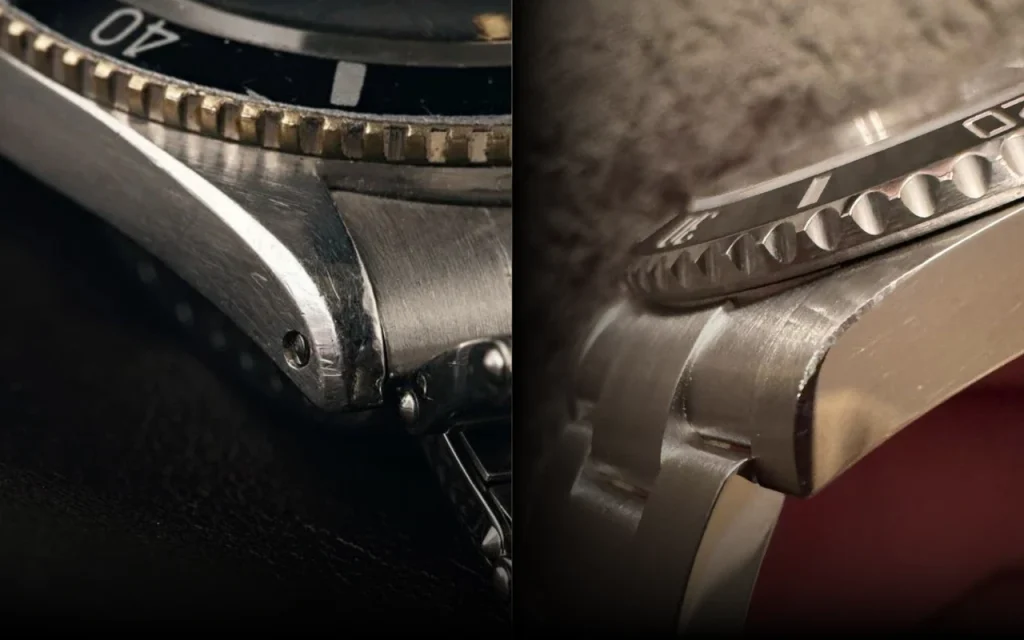
The finish also affects how visible scratches are. A polished surface reflects light strongly, making fine scratches and hairlines easy to see. Brushed and satin surfaces have a textured appearance that can make lighter marks less noticeable.
This does not necessarily mean a brushed case is harder to scratch. It simply makes everyday wear less noticeable.
Stainless Steel
316L is one of the stainless steel grades widely used in watchmaking. However, the particular steel, surface treatment, and case finish all influence scratch resistance.
316L vs 904L Stainless Steel
Rolex began using 904L stainless steel in its watches in 1985 and later began referring to its proprietary version as Oystersteel. However, 904L does not automatically mean a watch case will resist scratches better than a comparable 316L case.
Steel’s Real-World Scratch Resistance
Some brands use surface-hardening treatments or coatings on steel cases to improve scratch resistance, which can make a noticeable difference compared with untreated steel. Finish also matters: a polished steel case can show fine marks clearly, while a brushed finish can make similar wear much less obvious.
When marks do build up, stainless steel is one of the more straightforward case materials to professionally refinish when appropriate. However, polishing removes a small amount of material, so it should be carried out carefully to preserve the original case shape and finishing.
Titanium
Titanium is popular for watch cases because it is lightweight, strong, and highly corrosion-resistant.
It is noticeably lighter than stainless steel, making it particularly useful for larger sports watches where reducing weight can make a difference on the wrist.
However, strength does not automatically mean high scratch resistance. Titanium can behave quite differently depending on its grade, surface treatment, and finish.
Grade 2 vs Grade 5 Titanium
Grade 5 titanium is a titanium alloy containing aluminum and vanadium. It is stronger and generally harder than Grade 2, although scratch resistance still depends on the watch’s construction and surface treatment.
Rolex’s RLX titanium, used in the Yacht-Master 42 (ref. 226627), is a Grade 5 titanium alloy selected for its strength and corrosion resistance.
Surface-hardening treatments can further improve titanium’s resistance to scratches, which is why two titanium watches can wear quite differently even when they use the same base material.
Protective film can provide an additional barrier against cosmetic wear for titanium watches, particularly when the surface is suitable for application.
Ceramic
Ceramic is among the hardest materials commonly used for watch cases, although its exact properties depend on the ceramic formulation. This high hardness makes it highly resistant to everyday scratches.
Ceramic is highly resistant to corrosion and can retain its finish well under normal wear. Depending on the construction, it can also be relatively light compared with some metal cases and allows manufacturers to create colors that can be difficult to achieve with conventional metals.
The main trade-off is brittleness. Ceramic can resist scratches extremely well while remaining vulnerable to sufficiently hard impacts.
What Happens When Ceramic Gets Damaged
A sharp impact against a hard edge or a significant drop can cause ceramic to chip or crack rather than simply scratch. This is particularly relevant around edges and thinner sections of the case.
Unlike a scratched metal case, a chipped ceramic component usually cannot simply be polished back into its original shape. Depending on the watch and extent of the damage, replacement may be the practical solution.
Ceramic’s high scratch resistance is a major advantage, but it doesn’t make the material immune to impact damage.
Gold
Gold is one of the softer common watch case materials and is available in yellow gold, white gold, and rose gold.
Gold remains popular for its distinctive appearance and precious-metal value. Pure 24-karat gold is extremely soft, so watch cases are typically made from gold alloys containing other metals to improve hardness and durability.
Does Higher-Karat Gold Mean Harder
Not reliably. Higher-purity gold is generally softer, but the hardness of a watch case also depends on its specific alloy and manufacturing process.
Karat is therefore not enough to determine how scratch-resistant a particular gold case will be.
Living With a Gold Case
A gold watch will generally pick up fine marks more readily than steel or titanium under the same everyday contact. Some owners leave these marks as part of the watch’s natural wear, while others choose to have the case refinished.
Gold cases can generally be professionally refinished when appropriate, although repeated polishing removes a small amount of material over time. Care is therefore important when restoring an older or collectible watch.
Platinum
Platinum is one of the most prestigious precious metals used in watchmaking and is valued for its density, durability, and distinctive appearance.
Watchmaking platinum is commonly around 95% pure and may be marked 950. Its high density also makes a platinum watch substantially heavier than an equivalent watch in stainless steel or titanium.
Despite its durability, a platinum watch case can still develop fine scratches through everyday wear.
How Platinum Handles Everyday Wear
Platinum wears differently from gold. Everyday wear can give platinum a smooth, worn appearance over time. Some owners prefer to keep this look rather than repeatedly polishing the case back to a mirror finish.
A brushed finish or the way platinum develops a worn surface over time can make some marks less noticeable.
Some owners choose to protect the case to slow visible wear, while others prefer to let the platinum develop its natural appearance and refinish it when necessary.
Bronze
Bronze is generally more prone to visible surface wear than stainless steel or hardened titanium and is valued for its warm, coppery tone and ability to develop a distinctive patina.
Most watchmaking bronze alloys are based on copper and tin, although copper-aluminum alloys are also used. The exact hardness and behavior depend on the alloy.
As bare metal, bronze generally scratches more easily than stainless steel or hardened titanium. Bronze changes appearance over time, so those scratches can eventually become less noticeable.
What Happens When Bronze Gets Scratched
A fresh scratch exposes brighter metal underneath the surrounding patina, so it can stand out at first.
As the exposed area develops further patina, the contrast can become less noticeable. The scratch hasn’t disappeared, but the developing patina can make it less noticeable over time.
This changing appearance is part of the appeal of bronze watches for owners who prefer a naturally developing patina.
If a bronze case is professionally polished, some or all of the developed patina may be removed, effectively resetting part of the aging process.
Carbon Fiber and Forged Carbon
Carbon composites are valued for their low weight and good strength-to-weight ratio. This makes them popular in sports watches and other performance-focused pieces where reducing weight is important.
However, carbon fiber and forged carbon cases do not have one universal level of scratch resistance. The surface you actually touch can behave very differently from the carbon structure underneath.
What Affects Carbon Case Scratch Resistance
A carbon case may contain carbon fibers, resin, protective coatings, or other finishing materials, so the surface itself can have a major effect on how easily marks appear.
A dark, matte, or textured finish may also make light scratches less noticeable. As a result, a carbon watch can be very light and strong while still being susceptible to surface scratches.
Minor surface damage may sometimes be addressed depending on the construction and finish. Deeper damage that reaches into the composite structure is more complicated, and repairs can be difficult because distinctive forged-carbon patterns are not always easy to reproduce exactly.
Tungsten Carbide and Other Hardened Cases
Tungsten carbide is an extremely hard material used in some watch cases and can offer excellent resistance to everyday scratching.
Like ceramic, it can maintain a clean surface despite regular contact that would leave marks on softer materials. Its main trade-off is that it can be more brittle than conventional watch metals.
What Happens If Tungsten Carbide Chips
The exact behavior depends on the material and case construction, but tungsten carbide should not be considered immune to impact damage.
If a case does chip, repair options can be limited. Its extreme hardness also makes conventional polishing impractical compared with materials such as stainless steel or gold.
Tungsten carbide offers excellent scratch resistance, but its brittleness and limited refinishing options are important trade-offs.
Coated Cases and Other Hardened Options
Some watches use specially coated cases, where a hard, thin surface layer is applied over a different material to improve scratch resistance.
These coatings can significantly improve surface scratch resistance, depending on the coating and application.
Aluminum and Plastic Cases
Aluminum is occasionally used in lightweight sports watches and some lower-cost models.
Its main advantages are low weight and ease of machining, but it is a relatively soft metal and can dent and scratch more readily than stainless steel.
Plastic and resin cases are used in sports, quartz, and other watches where low weight, durability, and design flexibility are priorities. They are generally chosen for their low weight, cost, durability in certain applications, and flexibility in color and design rather than maximum scratch resistance.
Watch Case Materials Comparison
Scratch resistance is only one part of the decision. Weight, impact resistance, and repairability also matter.
| Material | Scratch Resistance | Key Consideration |
| Stainless steel | Moderate | Durable and easy to refinish |
| Titanium | Low to high | Depends on grade and treatment |
| Ceramic | Very high | Scratch-resistant but can chip |
| Gold | Low | Scratches easily but can be refinished |
| Platinum | Moderate | Heavy and develops visible wear |
| Bronze | Low | Scratches easily and develops patina |
| Carbon / forged carbon | Varies | Very light, but repairs can be more difficult |
| Tungsten carbide | Very high | Very hard, but can be brittle |
These are general comparisons. Actual performance can vary with the alloy, grade, construction, surface treatment, and finish.
Does the Watch Finish Affect How Visible Scratches Are
Yes. The finish can have a significant effect on how noticeable scratches are. Two watches made from the same stainless steel or titanium can look completely different after a year of daily wear simply because of how their cases are finished.
A polished surface behaves almost like a mirror. Light reflects strongly from the smooth surface, so anything that disrupts that reflection, even a fine hairline, can stand out.
This is why polished bezels, case edges, and polished bracelet links often show wear quickly.
Brushed and satin finishes work differently. Their fine surface texture scatters reflected light, making lighter marks less obvious.
A scratch running roughly in the same direction as the brushing may blend into the existing texture, while one running against the grain is more noticeable.
If you want a watch that hides ordinary daily wear better, a brushed or satin finish will generally be more forgiving than a highly polished one, regardless of the underlying metal.
Where Do Watch Cases Usually Get Scratched
Most scratches don’t come from dramatic accidents. They build up from ordinary contact repeated over months and years.
Common sources include:
- Desks and countertops: Resting your wrist while typing or writing can cause repeated contact with hard surfaces.
- Door frames and car doors: These can catch the case sides, lugs, or bezel as you move.
- Laptop edges and equipment: Hard edges can leave marks when the wrist or case brushes against them.
- Clothing: Jacket zips, shirt cuff buttons, and other hardware can rub against the watch.
- Jewelry: Rings and bracelets worn on the same wrist can mark a case or bracelet.
- Other watches: Storing watches together without separation can result in metal-on-metal contact.
- Hard surfaces: Placing the watch face-down or directly against a rough surface can cause avoidable scratches.
Lugs, case edges, polished bezels, bracelet links, clasps, and other high-contact areas tend to show wear first.
How Can You Prevent Scratches on a Watch
Simple changes to how you wear and store the watch can reduce avoidable scratches:
- Take it off for rough work or sport. Repeated contact with tools, equipment, or hard surfaces increases the chance of scratching or impact damage.
- Store it away from other jewelry. Keeping a watch separate from rings, bracelets, and other watches reduces metal-on-metal contact.
- Be careful where you rest your wrist. Desk work can contribute to everyday wear, particularly when the case or bracelet repeatedly contacts the surface.
- Avoid placing the watch directly on hard surfaces. Use a soft watch pouch or suitable surface when taking it off.
None of these habits makes a watch scratch-proof. Even highly scratch-resistant materials can eventually develop marks through repeated wear.
Protective film is another option for reducing cosmetic wear during everyday use.
Can Watch Protection Film Help Prevent Scratches
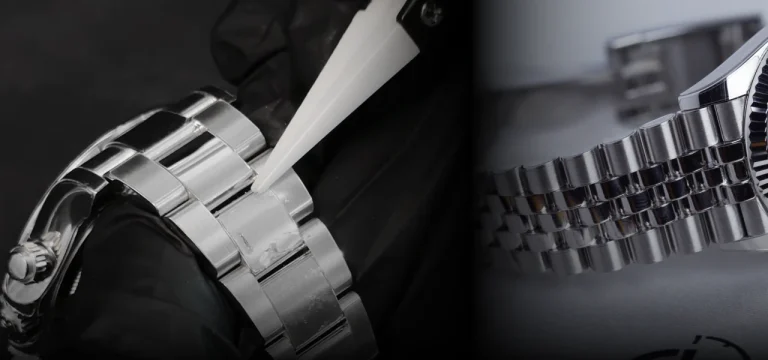
Watch protection film adds a protective layer between the watch and everyday contact, helping reduce light scratches and scuffs on suitable surfaces. It is designed for cosmetic protection, not to prevent dents, cracks, or damage from hard impacts.
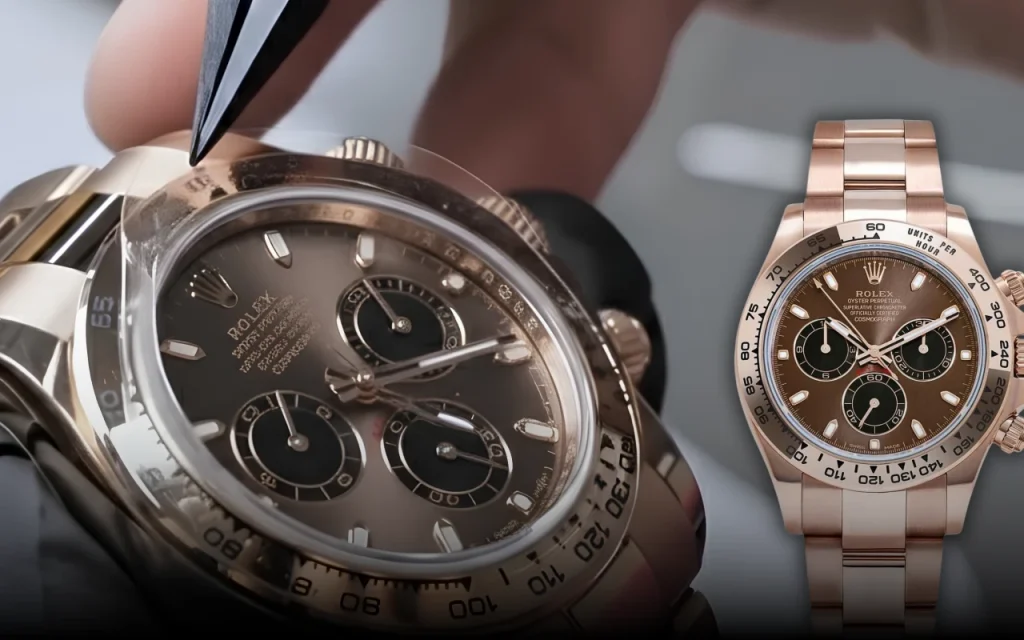
Film can be particularly useful on softer materials and highly polished finishes, where everyday marks tend to be more noticeable. It can also be applied to suitable ceramic or tungsten carbide surfaces, depending on the watch and intended coverage, although it does not increase the material’s inherent scratch resistance.
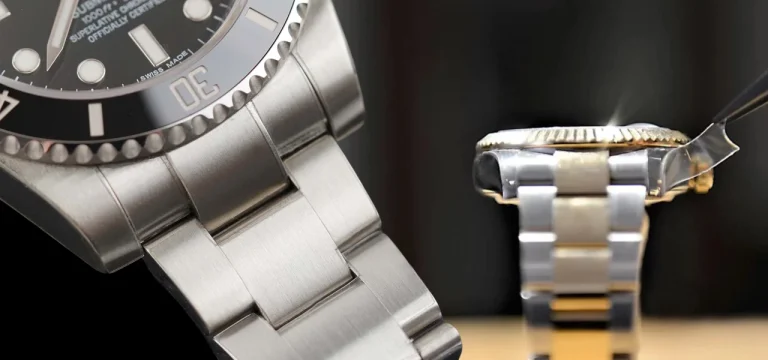
A properly fitted film should be cut to the specific watch so it can follow the contours of the case, including polished bezels, brushed case flanks, and faceted lugs where appropriate. The condition of the case also matters before application. Protection film is intended to preserve suitable existing surfaces, not repair dents, chips, or significant scratches.
Watchskins uses 3M Premium TPU Film with model-specific laser-cut patterns, freshly cut and applied in-house in Singapore to match the watch and intended coverage.
Frequently Asked Questions
1. Which watch case material scratches the least?
Ceramic and tungsten carbide generally offer the strongest resistance to everyday scratching, while properly hardened metal surfaces can also perform very well. However, ceramic and tungsten carbide can be more vulnerable to chipping or cracking under a hard impact.
2. Is titanium more scratch-resistant than stainless steel?
Not necessarily. Untreated titanium can scratch relatively easily, while hardened or surface-treated titanium can offer much better resistance. The specific grade, treatment, and finish all matter.
3. Does ceramic ever scratch?
It can, although ceramic is highly resistant to everyday scratches. Its more significant weakness is that a sufficiently hard impact can cause chipping or cracking.
4. Can a scratched gold or platinum watch be restored?
Generally, yes. Both gold and platinum cases can often be professionally refinished to reduce the appearance of surface marks. However, repeated polishing removes a small amount of material over time.
5. Can watch protection film prevent dents or cracks?
No. Protection film is designed primarily for surface scratches and everyday cosmetic wear. It cannot prevent the case underneath from denting, cracking, or chipping after a significant impact.
6. Does a brushed watch case hide scratches better?
Generally, yes. Brushed and satin finishes tend to make light scratches less noticeable than polished surfaces because their texture scatters reflected light.
Final Word
If scratch resistance is the priority, ceramic and tungsten carbide generally offer excellent performance, while properly hardened metals can also provide strong surface resistance. Stainless steel remains a practical all-rounder because it balances durability, everyday wear, and refinishing options.
Titanium’s scratch resistance depends heavily on its grade and surface treatment. Gold and bronze tend to show marks more readily, while platinum and carbon-based cases have their own trade-offs depending on their construction and finish.
Key Takeaways
- Hardness and toughness differ. Ceramic and tungsten carbide resist scratches well but can chip under hard impacts.
- Treatment and finish matter. Hardened metals can resist scratches better, while brushed finishes can make marks less noticeable than polished ones.
- Softer materials show marks more readily. Gold and bronze tend to scratch more easily, although their changing appearance can become part of the natural aging process.
- Protection film helps with daily wear. It can reduce everyday scratches and scuffs on suitable surfaces, but it is not designed to prevent impact damage.
Every watch case can pick up signs of everyday wear, regardless of the material. Watch protection film adds a barrier against scratches and scuffs while helping preserve the original finish. Protect your watch with Watchskins protection film made from 3M TPU. Each film is custom-measured and precision laser-cut with model-specific patterns for an accurate fit.